
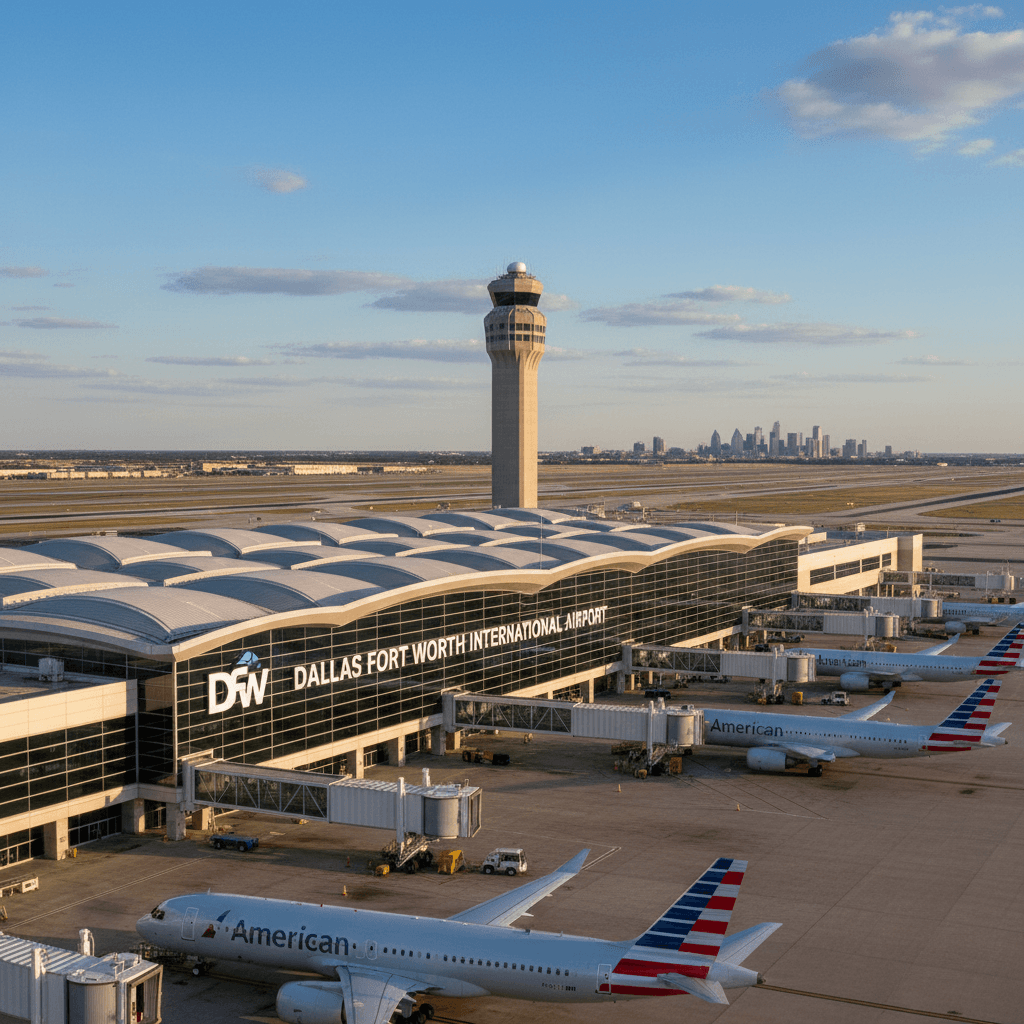
Dallas Fort Worth International Airport
Dallas-Fort Worth · United States · Updated Apr 20, 2026
- Code
- DFW
- Size
- Major Hub
- Terminals
- 6
On this page
Overview
Dallas Fort Worth International Airport (DFW) is the primary international airport serving the Dallas-Fort Worth metroplex in North Texas, Texas, United States. It is the second-largest airport by land area in the US, spanning 17,207 acres, and handles service to 269 destinations.
DFW is located halfway between Dallas and Fort Worth, covering parts of Dallas and Tarrant counties. It features six terminals with 224 gates and is a major hub for American Airlines. The airport is the busiest in Texas for international traffic and the largest carbon-neutral airport in the world. It offers extensive nonstop service, more than any other North American airport as of 2023.
Getting to and from the airport
DART Rail
Orange Line from Terminal A to Downtown Dallas.
45-60 minutes · $2.50-$6
TEXRail
From Terminal B to Fort Worth.
20-40 minutes · $2.50-$5
Skylink
Free airside train between terminals.
2-10 minutes · Free
Rental cars are available from all terminals via shuttle; taxis and rideshares queue curbside with flat rates to downtown areas. Public transit via DART Orange Line at Terminal A or TEXRail at Terminal B offers economical options to Dallas or Fort Worth. Avoid peak hours for faster access.
Security wait: 15-30 minutes average
Terminals and airlines
A
Serves DART Orange Line station; domestic focus.
B
TEXRail and DART Silver Line station; domestic.
C
Connected to Terminal D via skybridge.
D
International terminal, opened 2005, handles 11.7M passengers/year.
E
Domestic operations.
Airlines: American Airlines
Tips for travellers
- Use the Skylink train to move between terminals airside; it replaced the older Airtrans system.
- International arrivals process through Terminal D; allow extra time for connections via skybridge to Terminal C.
- DART Orange Line connects Terminal A to Downtown Dallas; TEXRail at Terminal B links to Fort Worth.
- Plan for Terminal A or B for ground rail access upon arrival.
- Skylink operates bi-directionally across terminals for quick intra-airport transfers.
Good to know
- DFW owns 17,207 acres, making it the second-largest airport by land area in the United States after Denver International Airport.
- It has its own ZIP code (75261) and designation as 'DFW Airport, TX', with dedicated police, fire, and EMS services.
- DFW is the first airport in North America to achieve carbon-neutral status and serves 269 destinations (196 domestic, 73 international).
- The Skylink automated people mover connects the five terminal airsides with 10 stations over 4.81 miles of track.
- As of April 2023, DFW offers more nonstop destinations than any other airport in North America.
Amenities: Lounges, WiFi, Dining and shopping, Skylink train, DART and TEXRail stations
Climate, customs and advisory
DFW experiences a humid subtropical climate with hot, humid summers (average high 96°F/36°C in July) and mild winters (average low 36°F/2°C in January). Thunderstorms are common in spring, and occasional ice storms occur in winter.
Customs: International arrivals at Terminal D; use Global Entry or Mobile Passport for faster processing. Expect standard US CBP procedures with declarations via app or form.
Sources (10)
- en.wikipedia.org (opens in a new tab)
- airport-technology.com (opens in a new tab)
- en.wikipedia.org (opens in a new tab)
- en.wikipedia.org (opens in a new tab)
- en.wikipedia.org (opens in a new tab)
- en.wikipedia.org (opens in a new tab)
- en.wikipedia.org (opens in a new tab)
- airport-technology.com (opens in a new tab)
- airport-technology.com (opens in a new tab)
- en.wikipedia.org (opens in a new tab)
Flying in for your cruise?
Tell us your sailing and we will help you with flights, a night before the cruise and the transfer to the ship.