
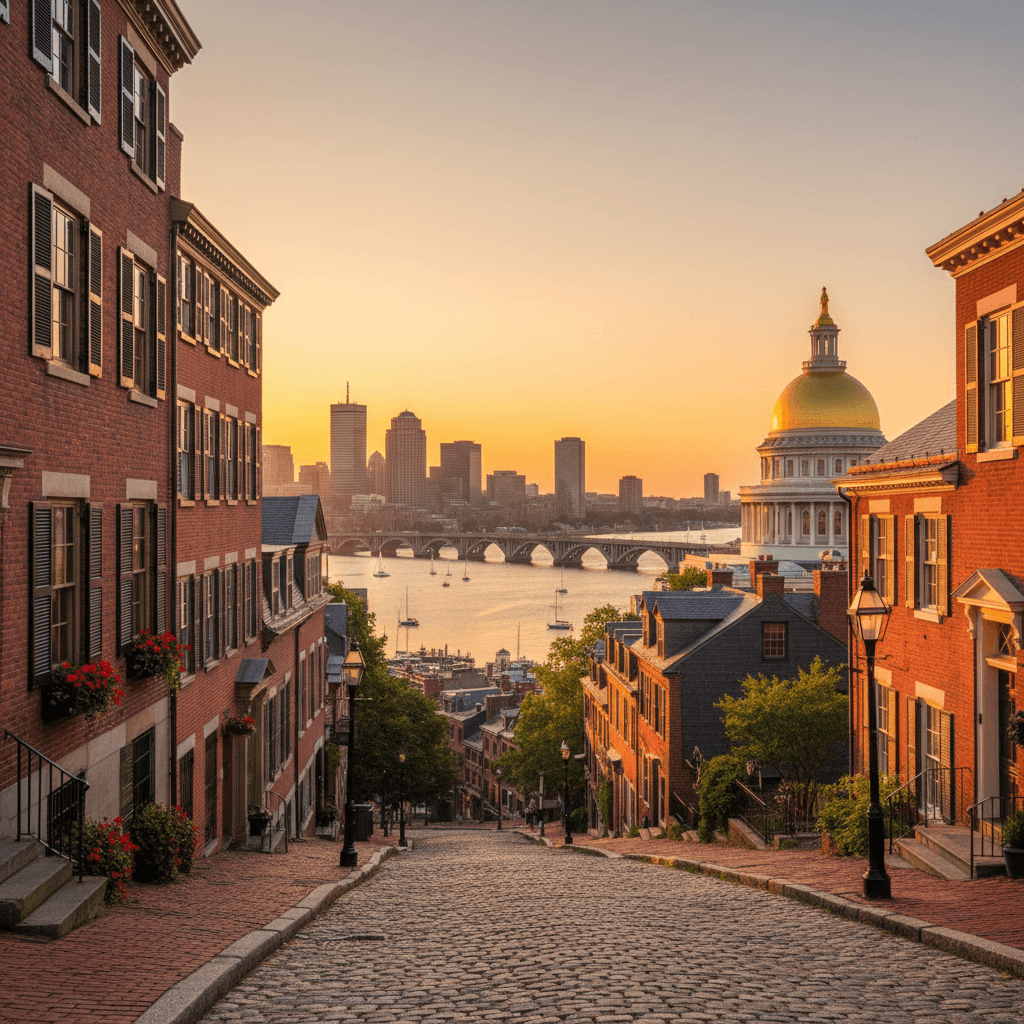
Boston
United States · New England, Northeastern United States · Updated Apr 20, 2026
- Language
- English
- Currency
- USD
Overview
Boston is the capital and most populous city of Massachusetts, serving as the cultural and financial center of New England in the Northeastern United States. With a population of 675,647 as of the 2020 census, it spans 48.4 square miles and is renowned for its pivotal role in American history, education, and innovation. The Greater Boston area houses nearly 5 million people, making it the largest metropolitan region in New England.
Best time to visit
Spring (April to June) and fall (September to October) offer mild weather, fewer crowds, and vibrant foliage, ideal for sightseeing and outdoor activities.
Good to know
- Boston boasts numerous 'firsts' in American history, including the nation's first public park (Boston Common, established 1634), first public school (Boston Latin School, 1635), and first subway system (Tremont Street subway, 1897).
- Founded in 1630, Boston played a central role in the American Revolution and grew as a key port, manufacturing hub, and intellectual center, later becoming a leader in education, medicine, and biotechnology.
- The city is home to world-renowned universities such as Harvard, MIT, and Boston University, establishing it as a major hub for higher education and research.
- Boston's professional sports teams include the Red Sox at historic Fenway Park (opened 1912), the Celtics and Bruins at TD Garden, and the New England Patriots nearby in Foxborough.
- The North End neighborhood, Boston's oldest residential area since the 1630s, is famous for its Italian-American heritage, restaurants, and tourist attractions.
- Boston Common, covering 50 acres in downtown, is the oldest public park in the United States, bounded by major streets like Tremont and Beacon.
Local tips
- Use the MBTA subway (the 'T'), the first in the U.S., for efficient public transit around the city and to nearby universities and suburbs.
- Walk the Freedom Trail to explore 16 historically significant sites, including Boston Common and the North End, starting from the Common.
- Visit Fenway Park for a Red Sox game or tour; book tickets early as it's the oldest Major League Baseball stadium.
- Try Italian cuisine in the North End, but expect crowds; go early or visit lesser-known spots for authentic cannoli and pasta.
- Explore Harvard and MIT campuses via free student-led tours; combine with a walk along the Charles River for scenic views.
- Check weather and layer clothing, as Boston's coastal location brings variable conditions; comfortable shoes are essential for its hilly, walkable streets.
Climate and travel advisory
Boston has a humid continental climate with four distinct seasons: cold, snowy winters (average January low around 23°F/-5°C), mild summers (average July high 82°F/28°C), and colorful autumns. Its coastal location moderates temperatures but brings frequent precipitation year-round, with about 44 inches of rain and 49 inches of snow annually.
Map
Sources (10)
- en.wikipedia.org (opens in a new tab)
- en.wikipedia.org (opens in a new tab)
- en.wikipedia.org (opens in a new tab)
- simple.wikipedia.org (opens in a new tab)
- en.wikipedia.org (opens in a new tab)
- en.wikipedia.org (opens in a new tab)
- en.wikipedia.org (opens in a new tab)
- en.wikipedia.org (opens in a new tab)
- en.wikipedia.org (opens in a new tab)
- en.wikipedia.org (opens in a new tab)
Cruise ports nearby
Thinking of Boston?
Tell us when you would like to go and how you like to travel. We will suggest the sailings, stays and days ashore that fit.