
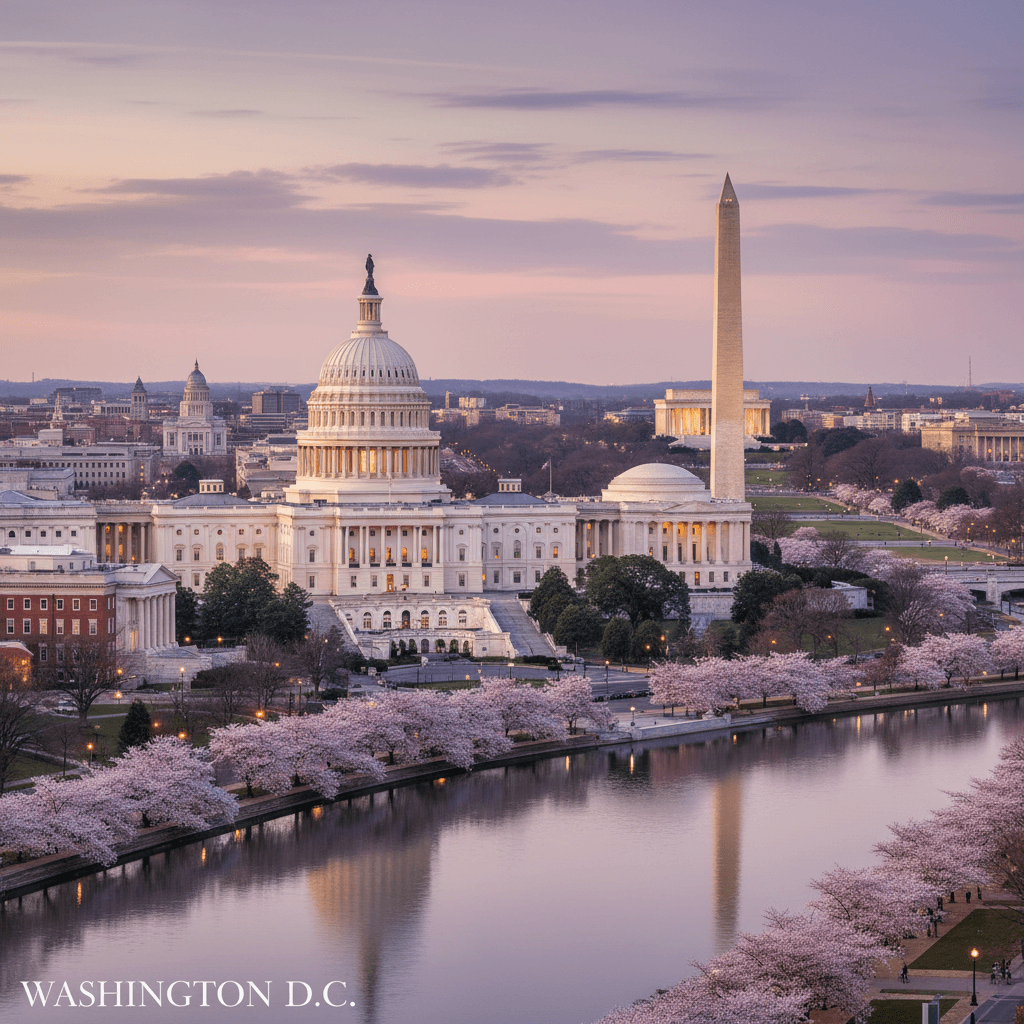
Washington, D.C.
United States · Eastern United States
Washington, D.C., officially the District of Columbia, is the capital city and federal district of the United States, located along the Potomac River between Maryland and Virginia. It is the nation’s political hub and a major cultural destination, known for its iconic monuments, world-class museums, and historic neighborhoods.
Best time to visit
Generally, the best times to visit Washington, D.C. are in spring (March to May) and fall (September to early November), when temperatures are milder and outdoor sightseeing is more comfortable.
Language
English
Currency
USD
Interesting facts
- Washington, D.C. is not part of any U.S. state; it is a unique federal district created by the U.S. Constitution to serve as the national capital. It was named after George Washington, the first president, while “Columbia” was a poetic name for the United States at the time.
- The city is laid out on a distinctive grid-and-diagonal street plan designed by Pierre (Peter) L’Enfant, with the U.S. Capitol serving as the reference point for the city’s four quadrants (NW, NE, SW, SE). Many avenues are named after U.S. states and radiate outward from key circles and squares.
- Washington, D.C. is one of the most visited cities in the United States, attracting tens of millions of visitors annually. In 2022, for example, it hosted an estimated 20.7 million domestic and 1.2 million international visitors, making it the seventh-most visited U.S. city.
- The National Mall—an open park area stretching roughly from the U.S. Capitol to the Lincoln Memorial—is lined with many of the Smithsonian Institution museums, which generally have free admission. This makes D.C. a relatively budget-friendly destination for museum lovers compared with many other global capitals.
- Despite its relatively small geographic size (about 68 square miles or 177 km²), Washington, D.C. has a dense and diverse population of roughly 690,000 residents within the district, and several million more in the surrounding metropolitan area of Maryland and Virginia.
- Washington, D.C. has a humid subtropical climate with four distinct seasons: hot, often humid summers; cool to cold winters with occasional snow; and pleasant, popular spring and autumn periods. The city’s famous cherry blossoms, many of which were a gift from Japan in 1912, typically bloom in late March to early April, drawing large crowds.
Local tips
- Use the Metrorail and Metrobus system to get around; staying near a Metro station (especially on the Red, Blue, or Orange lines) can save money and time compared with relying on taxis or rideshares.
- Many federal buildings and attractions (such as the U.S. Capitol and White House) require advance reservations and security screening; check official websites ahead of time and bring a government-issued photo ID.
- Wear comfortable walking shoes and carry water, especially in late spring and summer, as distances between monuments on the National Mall are longer than they appear on a map.
- Museum security can be strict: expect bag checks, and avoid bringing large backpacks or prohibited items to speed up entry at places like the Smithsonian museums and federal buildings.
- Peak cherry blossom season and major events (such as presidential inaugurations, large marches, or national holidays like the Fourth of July) dramatically increase hotel prices and crowd levels; book early if traveling during these times.
- Tipping customs follow typical U.S. norms: around 15–20% for table-service restaurants, $1–2 per drink at bars, and small tips for hotel staff and rideshare drivers are customary.